
LEARN ABOUT FREQUENTLY ASKED QUESTIONS.
“fuel treatments will not stop or eliminate fires.”
– David E. Calkin, Jack D. Cohen, et al., PNAS (2014).
Frequently Asked Questions
How much taxpayer money would Colorado Proposition 137 take away from state government?
Prop. 137 would take away an estimated $175 million per year through a sales tax on sporting goods from the State of Colorado general fund (already in a $1.6 billion deficit), and, in years of budget surplus, away from taxpayer refunds under the Taxpayer Bill of Rights (TABOR) in the Colorado State Constitution.
Do Prop. 137 sponsors have financial conflicts of interest?
Overwhelmingly. Prop. 137’s main sponsor, the $2 billion global land management NGO, The Nature Conservancy, contracts with government (federal and state) to carry out “fuel reduction” logging on public lands, for which the ballot measure would increase funding. Other sponsors, Western Resource Advocates and Conservation Colorado, are funded by corporate foundations (i.e. Pew Charitable Trusts is financed by fossil fuels money and Walton and Catena Foundations by WalMart money) that sponsor Prop. 137 and promote public lands logging across the U.S.
Does any science support Prop. 137’s main claim that cutting down/logging forests can “prevent wildfires?”
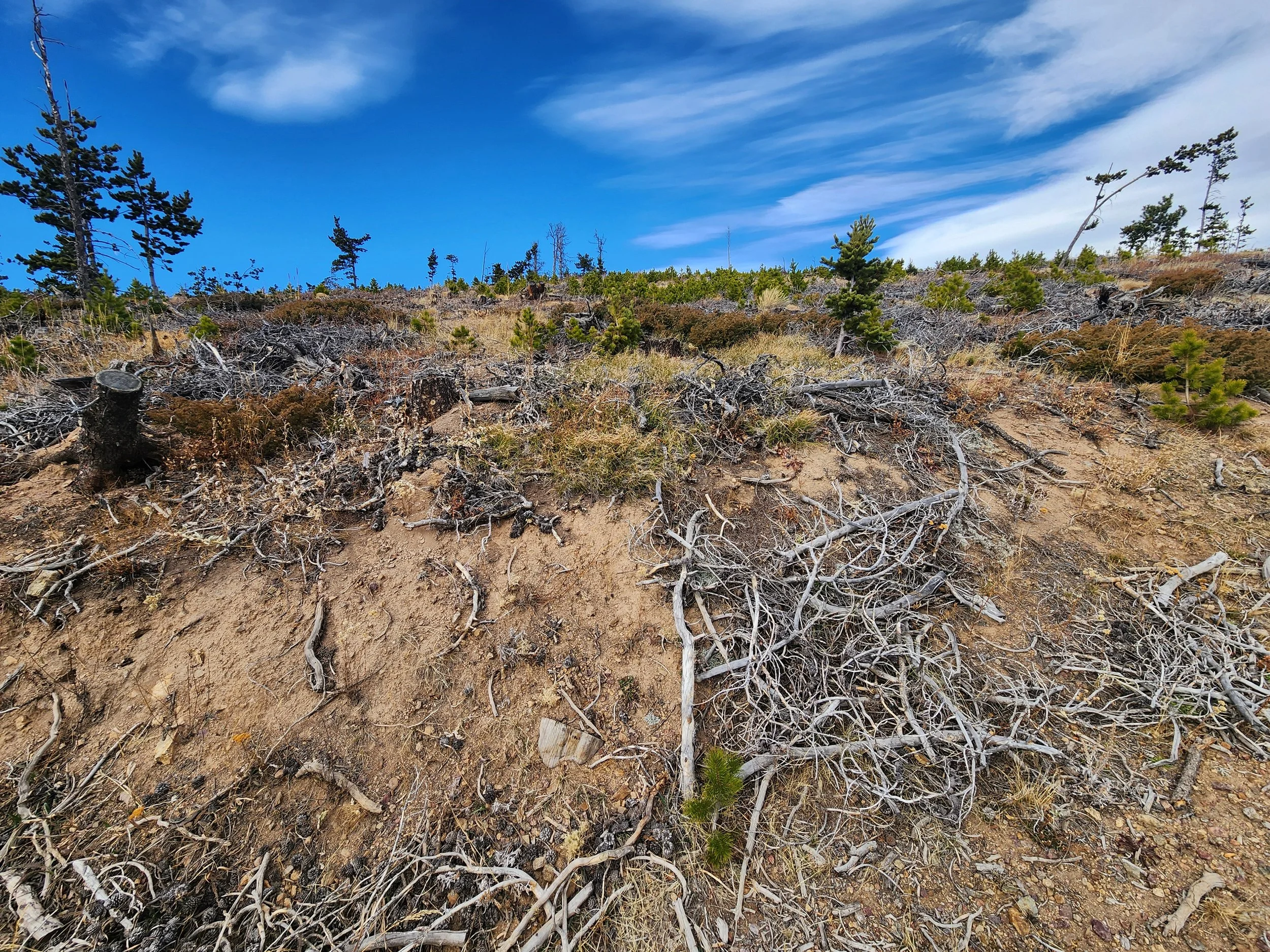
Not one single scientific study supports Prop. 137’s central claim (included in the text of the measure and name of the ballot issue committee) that cutting down/logging trees in the forest can “prevent wildfires.” Not only can’t “fuel reduction” slow the spread of fire to communities (U.S. Forest Service: “fuel treatments are not designed to prevent or stop fires but to moderate fire behavior when fire inevitably returns.”), it can rarely affect the weather- and wind- driven higher-intensity fires that threaten communities, such as the Marshall Fire (U.S. Forest Service: “fuel treatments that are unlikely to mitigate fire severity during extreme weather.”).
Does any science support claims from opposition to Prop. 137 that cutting down/logging forests increases community risk?
Nearly all of it. The consensus of peer-reviewed science—from independent studies to U.S. Forest Service (which carries out the most “fuel reduction” in the U.S.)—concludes that tree removal heats up and dries out the forest microclimate, opening it to wind, highly-flammable, fast-burning invasive grasses, and blowdown which can make wildfires more likely to ignite and spread embers and flames quicker to communities.
Have Prop. 137 sponsors really opposed protecting communities from wildfire?
Sadly, yes. In March 2026, Prop. 137 sponsors, including leadership from The Nature Conservancy, Western Resource Advocates, and Conservation Colorado (as well as many of the measure’s backers),testified against (and effectively killed) a bill in the Colorado State Legislature that would’ve routed a percentage of “wildfire mitigation” funding away from almost exclusively ineffective “fuel reduction” logging in the forest towards effective home protection/hardening grants for low-income, elderly, and disabled residents. The Nature Conservancy representative admitted in his testimony that, “we value this funding.”
How much industrial logging would Prop. 137 fund on public lands?
At least $73 million would go toward government funds that primarily, if not exclusively, finance “fuel reduction” logging on Colorado’s state, county, municipal and sometimes federal lands (through Good Neighbor Authority). Even some of the additional $83 million in “recreation” funding through Great Outdoors Colorado could fund “fuel reduction,” and in fact already has. If $73 million is spent on “fuel reduction” at an average cost of $3,000 per acre, that would be nearly 25,000 acres (40 square miles) per year.
Will Prop. 137 fund logging miles away from communities?
Definitely. Prop. 137 would fund ongoing logging on public lands miles away from communities, likely including backcountry Roadless Areas in National Forests through the Good Neighbor Authority (already occurring in Colorado Roadless Areas). Prop. 137 may also trigger matching funding from federal agencies to double the amount of logging.
Why are Prop. 137 backers claiming the measure wouldn’t fund logging?
Prop. 137 backers are cynically playing word games to confuse, mislead, and deceive the public as to the public lands logging it would fund. Government maps for “fuel reduction” in Colorado use the term “logging.” In Colorado, contractors who call themselves logging contractors are paid per acre with taxpayer dollars to carry out “fuel reduction” by logging trees—including clearcutting—and selling them (including large-diameter trees up to 211 years old) to sawmills, as well as for firewood, posts and poles, mulch, “biomass” energy, and other forest products.
Why are some NGOs supporting Prop. 137?
Many environmental organizations, including Center for Biological Diversity, WildEarth Guardians, Western Watersheds Project, and much of Colorado’s grassroots conservation community oppose Prop. 137. Unfortunately, Prop. 137’s NGO backers have either been “misinformed” (some of which have since withdrawn support), does or will receive taxpayer funding from Prop. 137 (i.e. The Nature Conservancy and most recreation orgs), and/or are funded by corporate foundations sponsoring Prop. 137 which bankroll extraction on public lands (i.e. Walmart/Walton family and Pew Charitable Trusts).
Why are some elected officials endorsing Prop. 137?
Several elected officials and political entities publicly oppose Prop. 137, including the Colorado Democratic Party, Colorado State Senator Judy Amabile, and State Representatives Emily Sirota and Tammy Story. Nearly every elected official in support of Prop. 137 works for or has worked for administrations that take taxpayer dollars to fund government agencies to carry out scientifically contested and/or debunked “fuel reduction” logging on public lands.